The Middle East has long sat in the aspirational tier of travel: futuristic skylines, desert resorts, hotel residences with helicopter pads. In 2026, that pull is fading fast. Mozio surveyed 1,004 travelers and found that 46% felt less likely to take a Middle East trip in 2026 than they did a year ago, more than four times the 11% who felt more likely. Only 26% were still considering a trip in the next 12 months, and 45% said the region hadn't crossed their mind at all.
But the pullback isn't the full story. Some travelers are accelerating bookings to catch a rare window of softer pricing and fewer crowds, while others are quietly canceling or hiding trips altogether. The result is a portrait of a market that hasn't backed off so much as fractured.
The split between travelers leaning in and travelers leaning out was sharp, and it didn't break cleanly along the lines anyone might expect.

Nearly 3 in 10 travelers (29%) said they were actively pulling back from a 2026 trip. About 17% had ruled out a Middle East trip entirely, 8% were delaying a trip they had previously planned, and 5% were rerouting to a different region.
But pullback wasn't the whole story. Another 29% of travelers said they on are doing the opposite and accelerating a Middle East booking. Their top reasons why included:
Past experience tilted positively. Among travelers who had visited the Middle East before, 27% said the experience was better than expected, and 13% said worse, a roughly 2-to-1 ratio. The people most likely to dismiss the region were those who had never been. Among travelers who had never visited the Middle East, 59% said the region hadn't crossed their mind for the next 12 months, compared with just 22% of those who had been before.
We also uncovered a pre-booking shift among travelers. About 1 in 5 (19%) said they now pre-book ground transportation more often than they used to, while just 6% pre-book less often.
Pulling back from the Middle East didn't mean writing off the whole region. The travelers who delayed, rerouted, or ruled out a trip were targeting a specific part of it.

Following the escalation of U.S.-Iran hostilities in late February 2026, the State Department moved six Gulf states (UAE, Saudi Arabia, Qatar, Oman, Kuwait, and Bahrain) from Level 2 to Level 3 "Reconsider Travel." Egypt, Turkey, Morocco, and Jordan remained at Level 2 "Exercise Increased Caution." When travelers reshuffled their 2026 itineraries, they tracked those advisory tiers more closely than a blanket-avoidance read would suggest.
Level 3 destinations were collectively swapped out of plans at 15.2% and swapped in at 9%, a net loss of 6.3 percentage points. Level 2 destinations swapped out at 8% and in at 8.3%, a net of +0.3 percentage points. Level 3 destinations were losing travelers. Level 2 destinations were holding steady.
The Egypt-versus-UAE comparison made the discernment look even sharper. Travelers swapped Dubai out of their itineraries at 5.1%, more than twice the 3.6% who swapped out Cairo. Combining Dubai and Abu Dhabi, the UAE was being dropped from plans at 2.1 times the rate of Egypt. Both are Middle Eastern countries. Only one was being treated as off-limits.
But the discernment wasn't perfect. Muscat, in Level 3 Oman, gained a small net share of travelers, the only Gulf destination to do so. Cairo, in Level 2 Egypt and serving as a primary regional departure hub, still posted a net loss of 1.3 percentage points. Petra (Jordan) and Doha (Qatar) showed similar mild drops. The data pointed to a spillover penalty: Middle East destinations were paying some price for proximity regardless of their actual advisory status, but the price was much smaller for destinations outside the active conflict zone.
The future-visit question added one more wrinkle. When travelers were asked which Middle East destination would be the most visited a year from now, 39% picked Dubai, more than double Cairo (17%) and triple Istanbul (13%). Dubai was both the most-swapped-out destination of 2026 and the one travelers most expected to dominate by 2027. The pullback was being read as temporary.
For travelers, the trip often gets decided in the airport, not at the hotel, and the arrival experience is where 2026 anxiety is showing up most clearly.
More than 1 in 4 travelers (26%) said they would avoid every Middle Eastern airport on the map. When asked which one felt safest, the most common answer was "none of them." It was the single biggest signal of blanket regional avoidance in the study, more than any country-specific concern.
For the travelers who would still fly in, confidence was uneven. The top three most trusted Middle East airports were Istanbul, Dubai, and Cairo. The bottom three were Kuwait, Bahrain, and Riyadh. About 1 in 4 travelers (26%) said they would route around Kuwait specifically, consistent with its bottom-ranked confidence score.
Travelers' top arrival worries included:
The gender split was stark: 41% of female travelers cited personal safety during the airport-to-hotel ride as a top arrival worry, compared with 23% of male travelers.
A gender gap also showed up in spending intent. Seven in 10 travelers said they would pay above the standard fare for a vetted, pre-booked Middle East airport transfer. Among women, that number climbed to 75%, compared with 64% of men.
Beyond arrival logistics, travel concerns ran in this order:
Among female travelers, 45% cited dress code expectations as a top concern, while only 20% of male travelers said the same.
Some travelers aren't telling anyone they're going to the Middle East. Some are pretending they didn't go. Some are pretending they did. The common thread is that the social cost of a Middle East trip, real or imagined, is now factored into the decision.

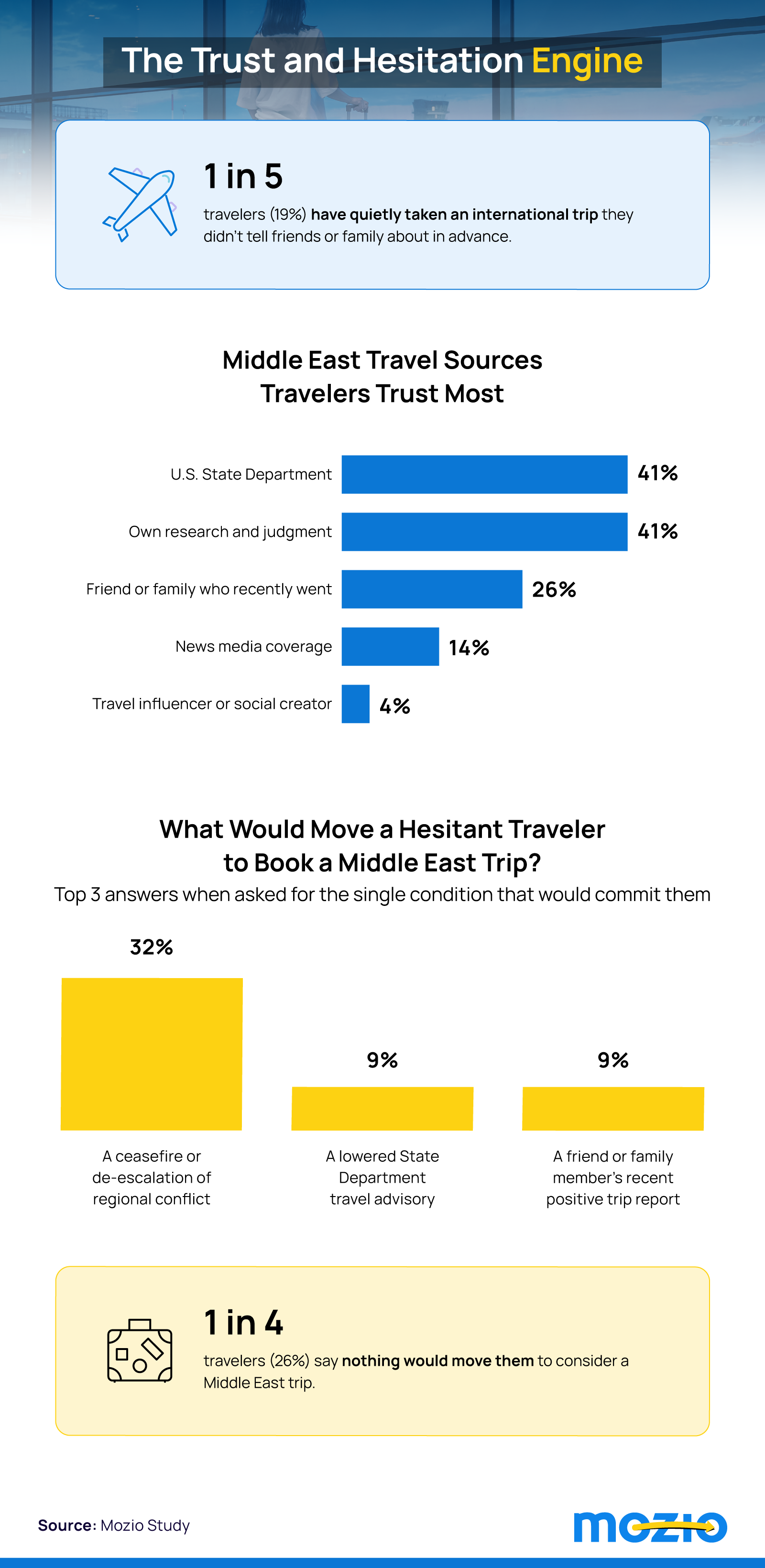
Nearly 1 in 5 travelers (19%) took an international trip they didn't tell friends or family about in advance. It was the most common form of hidden travel in 2026, and it sat alongside other small workarounds:
When asked which sources they trusted most for Middle East travel decisions, with up to two selections allowed, travelers picked:
Only 4% trusted travel influencers, a strikingly low number in a year when the broader travel industry has leaned hard into creator partnerships. Travelers, at least on Middle East decisions, aren't buying it.
There was also a clear trust gap with news coverage itself. More than 1 in 4 travelers (26%) said news media coverage made the Middle East seem less safe than it actually is, while 12% said coverage made it seem safer.
When asked what single condition would actually move a hesitant traveler off the fence, the answers were:
Around a quarter of hesitant travelers (26%) said no condition would change their mind. The rest were waiting for the world to change shape around them, or for someone they already trust to go first.
The Middle East market in 2026 is not in freefall. A meaningful share of travelers is still booking, and they're spending more carefully on the parts of the trip that reduce friction. Pre-booked, vetted ground transportation is one of the clearest places that shows up in the data. For travel businesses building ground transportation into their offerings, that willingness to pay is a concrete signal.
We surveyed 1,004 travelers about how they view and plan a potential 2026 Middle East trip, with a focus on travel demand, airport perceptions, ground transportation, hidden travel behaviors, and the cultural concerns shaping their decisions. The sample included Gen Z (24%), millennials (53%), Gen X (19%), and baby boomers (4%). Destination-level demand was also analyzed against U.S. State Department travel advisory levels as of March 2026. Percentages that do not total 100% are due to rounding. Percentages that do not total 100% are due to rounding.
Mozio is a ground transportation platform that connects travelers and travel businesses with vetted transfer providers in more than 180 countries. Whether you're an individual booking an airport transfer or a travel company adding ground transportation to your product, Mozio handles the vetting, logistics, and local expertise. Learn more at mozio.com.
These findings are free to share for noncommercial purposes. If you reference the study, please link back to Mozio so readers can access the full results and methodology.